|
BOUDINOT
HOUSE SITE |
|
|
|
|
|
BOUDINOT
HOUSE SITE |
|
|
One of the hot topics of the newspaper was the question of emigration to the west. When Elias Boudinot, editor of the Cherokee Phoenix, along with Major Ridge and John Ridge, came to the conclusion that voluntary removal was the only answer to what they believed was an inevitable forced removal, it became a significant source of tension between John Ross, his supporters for standing firm, and those individuals belonging to what came to be known as the Treaty Party. |
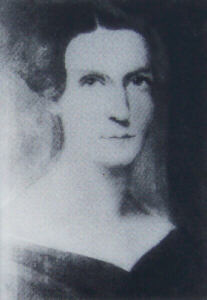
Harriet Gold Boudinot |
 |
|
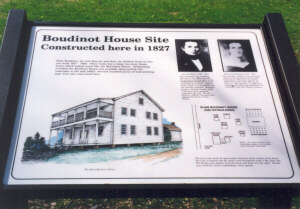
I have chosen to start this page with Harriet because once we start talking about the treaty, the focus will be entirely on Elias and the Ridges; and Harriet, among others, also has a worthwhile story to tell. A sign at the site explains; "She met Elias while he was attending school in her hometown of Connecticut. They were married in 1826 and moved to New Echota the next year. She died here in 1836 from complications following childbirth and is buried in the New Echota cemetery." What the sign does not tell us, I will be quoting from the movie documentary "The Trail of Tears" by Rich-Heape Films (available in both the trade center and our lending library). Elias, along with a few other Cherokees, including his cousin John Ridge, traveled to Cornwall, Connecticut in 1817 to study at the American Board of Commissioners for Foreign Missions school. The school had students from as far away as the South Pacific, and was primarily for "people of color." "White America had extended a promise to Native Americans. They could become civilized and they could become Americans. And, they could participate as equals. What Ridge and Boudinot found, in fact, was that the promise was empty." While in Cornwall, Elias and John fell in love with two daughters of the town. Elias' wish to marry Harriet, and John Ridge's desire to marry Sarah Northrup, were "met with such disapproval that at one point Harriet watches town members, people that she knows, that she goes to church with, burning her in effigy because they are so upset with her decision to marry Elias Boudinot. The girls of her choir show up to church with black armbands to demonstrate their mourning of her decision to marry this --- the newspaper uses quotes like 'dusky son' or 'savage son.' These same people who had welcomed them with open arms as 'children of the forest' now were completely in arms because they had married white women . . . . . . after this incident Boudinot and Ridge were very well aware where they stood in America. They could be civilized; as civilized as they wanted to be. They could be as rich as they wanted to be. But they were not white, and white America was not prepared to accept them on an equal basis." Harriet took a lot of flak, and showed great courage and fortitude in following her heart. I felt it was worthy of a moment's reflection. |
 |
|
||||||
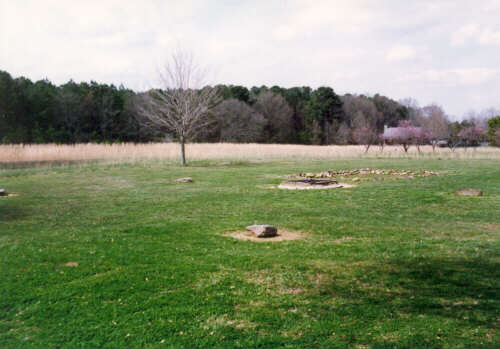
| Archaeology revealed the Boudinot House was probably destroyed by fire sometime in the mid-1800's. Several hundred pieces of lead printing type were also uncovered here." | |
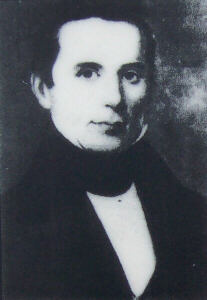 Elias (c. 1803 - 1839) |
 |
|
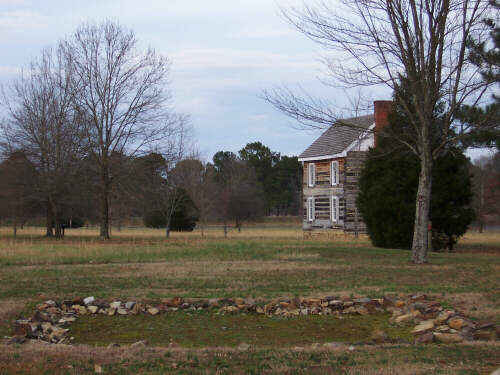
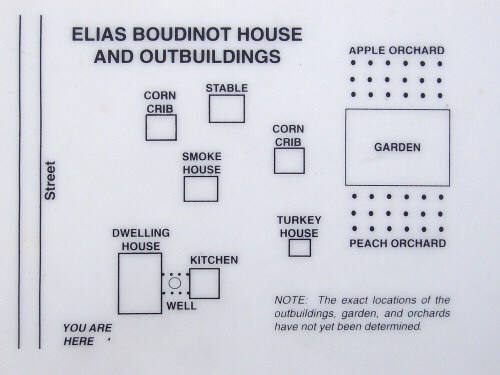
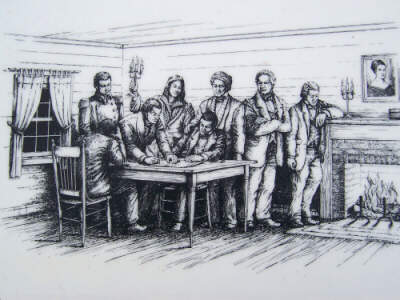
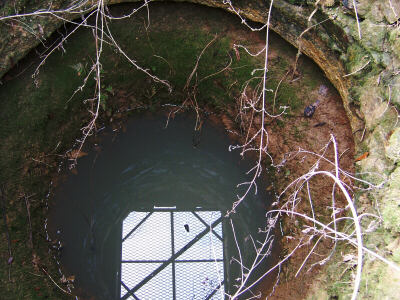
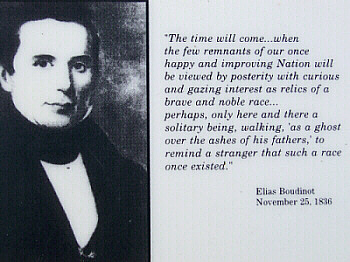
The same sign from which Harriet's information was taken, tells us, "Elias Boudinot was a leading Cherokee of the 1820's and 30's. He served as the first editor of the CHEROKEE PHOENIX and also translated many books, religious tracts, hymns and pamphlets into the Cherokee language. Boudinot became a leading member of the treaty party who supported removal to the west. He was killed in 1839 by Cherokees who opposed the Treaty of New Echota." The SGT brochure/map starts the same then adds a little more. "Elias Boudinot was a leading Cherokee of the 1820's and 30's. He served as the first editor of the CHEROKEE PHOENIX and also translated and published many religious tracts, books, and pamphlets into Cherokee. Boudinot constructed a large two-story frame house on this site in 1827. The four stones mark the approximate locations of the corners of the house. The well is original and the square area enclosed by rocks is the cellar site. The kitchen was separate from the house and built over the cellar. Nearby was a garden, orchards, and several outbuildings. The Treaty of New Echota was signed in the Boudinot House on December 29, 1835 by twenty Cherokees. Although it was never endorsed by the Cherokee government and was considered fraudulent by many Cherokees, the treaty was ratified by Congress and used as justification to forcibly remove the Cherokees in 1838. Boudinot was assassinated in 1839 by Cherokees who opposed the treaty." |
| Persons
of great courage or traitors? It's a tough call all the way around.
(sign text reprinted below) |
 |
|
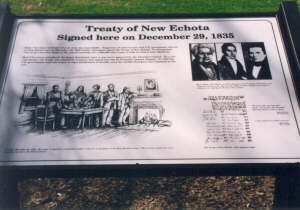
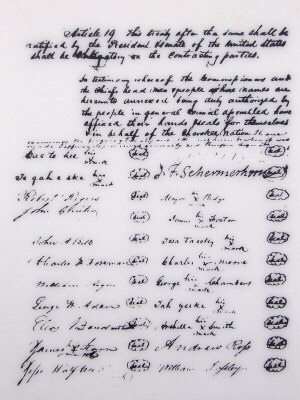
"Some Cherokees believed removal west was unavoidable. Supporters of removal met with U.S. government officials at New Echota and on December 29, 1835 twenty Cherokees signed the Treaty of New Echota. It relinquished title to all Cherokee lands in the east in exchange for $5,000,000 and a tract of land in what in now Oklahoma. Most Cherokees considered the treaty fraudulent since it was never approved by the Cherokee Council. By a one vote margin the treaty was ratified by Congress and signed into law by President Andrew Jackson. In 1838 the U.S. government used the treaty as legal justification to forcibly evict the 15,000 Cherokees who remained in the east." |
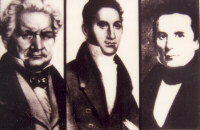 |
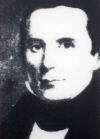
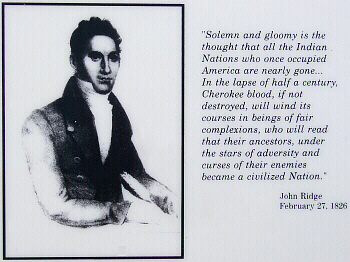
"Major Ridge, John Ridge, and Elias Boudinot led the group of Cherokees who supported removal west. On June 22, 1839, all three of them were killed in retaliation for signing the Treaty of New Echota." It was written right into the Cherokee Constitution that to sell or trade away Cherokee lands was punishable by death. Unfortunately they never made it to due process. They were assassinated. |
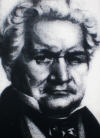 |
"I
have signed my death warrant."
- Major Ridge |
"We
will make and sign this treaty . . . we can die, but the great Cherokee Nation will be saved."
- Elias Boudinot |
 |
 |
|
The SGT brochure/map closes by telling us "This completes the tour. We hope you have enjoyed your visit to New Echota. Follow the path back to the museum. If you have any questions, please feel free to ask members of our staff." However, I am going to ask you to stick around for just a little longer. Before we go, let's peek down into the original well together and take what may seem like a bizarre journey of the imagination. |
|
At the time I am writing this, my sister (with her family) and my mother both live in the city of Woodstock, which is located in Cherokee County, Georgia. It is on the southern edge of the county. Each time I have visited, the construction and traffic abound in this obviously affluent area of upscale businesses and very nice homes. Cindi, Robert, and Audra (my niece) live in a hilly development with hundreds of homes around them, yet a drainage creek cascading down along the edge of their property has provided me with a spot for quiet contemplation many times. |
 |
|
Mom lives in an older neighborhood of just a dozen or so homes with lots of trees, even though it is right off the highway and a main street. This is a thriving area. The county has sixteen towns, communities, or cities which appear on their online map. Their website says the countywide population was over 111,000 in 1995. With a stated expectation of topping 130,000 back in 2000, who knows what it is today. Yet, I have driven some of the back roads, and there is still plenty of woods and farmland if cities do not suit your needs. I would like you to imagine that you live there too. Imagine you have been hearing some rumblings and rumors for the past couple of years, about a big change coming which could impact everyone in the county. There has been a lot of talk and much written about the government's power of Eminent Domain, which allows them to confiscate private property. You have noticed some strangers lately, asking questions about how much Cherokee Indian ancestry everybody has. Like most people though, the details of everyday life keep you too busy to fret much about what might be going on. After all, this is America. What could really happen that might significantly disrupt life for you, your family, your neighbors and your friends? Then it does happen. Word gets out. The President of the United States, and the Governor of Georgia, responding to special interest pressures have been working on the concept of returning something to the Cherokee Nation. It seemed logical that the county which still bears our name would be chosen. They had not wanted to invoke Eminent Domain, so the U.S. government recently sent a delegation to meet at Canton with a group of well known county politicians who might be sympathetic to the idea. Although their names are familiar (as people long involved in county politics) to most county residents, the current mayors, county commissioners, and others holding office were not there; nor invited; nor even knew of the meeting until afterwards. A deal was struck. For several billions of dollars and a county in Texas where current Cherokee County residents can move, the entirety of Cherokee County will be returned to the Cherokee Nation. Although you had noticed the increasing presence of the Georgia National Guard recently, who can believe it? Understandably, people are shocked; dumbfounded really. Some are up in arms ready to fight this any way they need to. Others are contemplating possible lawsuits. County office holders get petitions ready to circulate protesting and declaring the obvious illegality and immorality of such an agreement arrived at outside of the public's eye. Practically the entire population of voting residents sign the petitions which are taken to Washington and presented to the U.S. Congress. In spite of the petitions, Congress validates the agreement anyway by a one vote margin. The President gives county residents two years to move voluntarily. The Georgia National Guard will continue its presence to keep order in those two years, but at the end of the allotted time, if the entire county has not been vacated, U.S. Army regulars will be sent in to forcibly complete the job. How can this be you ask? It is ridiculous! These are our homes, our businesses. Our relatives are even buried in these cemeteries. Nobody can still believe it. County officials practically live in Washington D.C. and Atlanta, as they knock on political doors trying to find allies who will stand up for what is right, and plain old common sense. They try to keep their constituents calm, suggesting business as usual while they get this thing worked out in the nation and state capitals. But . . . Two years pass. Some of your neighbors have already moved, yet 90% of the counties population remains. True to the threat, the U.S. Army is mobilized and sent into the county forcing people from their homes on a moments notice. You can take what you can grab and carry, but your "home" for the next few months will be a stockade, with little shelter, meager food allotments, and a general lack of sanitation. Some would probably like to take up arms and resist, but there is one well armed soldier for every two to three men, women, and children, currently in the county. It is hopeless. The story goes on of course, but this is where I will stop. If you were at all able to imagine such a bizarre scenario, then you can begin to understand what took place here at New Echota, and throughout the Cherokee Nation in the 1830's. "And you will know the truth, and the truth will set you free." - John 8:32 NLT There was one more sign on the way to exiting the New Echota grounds. Called "Echoes From the Past," it speaks of the restoration and reflection. "New Echota fell into ruin the years following the Cherokee Removal and by the late 1800's, the town was a distant memory to most people in this area. In the fall of 1889 a writer for an Atlanta newspaper visited here: 'Perhaps the best forgotten historic spot in Georgia is New Echota . . . We rode to the spot where the town was . . . there was nothing to be seen but a most beautiful and blessed field of ripening corn, which covered many acres. Throughout this level sea of golden grain an occasional green walnut tree dotted the scene. These were indices, it seemed to me, that pointed to where human habitations once stood, and where human voices filled the air, instead of sighing, rustling corn.' |
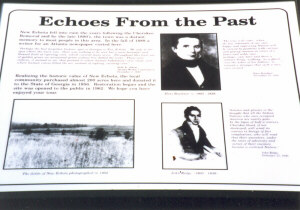 |
Belle K Abbott Realizing the historic value of New Echota, the local community purchased almost 200 acres here and donated it to the State of Georgia in 1956. Restoration began and the site was opened to the public in 1962." "We hope you have enjoyed your tour." |
 |
 |
|
|
| NEW ECHOTA MAIN PAGE |
|
|
|
|