 |
 |
 |
||||
|
|
|
Cherokee,
North Carolina |
|
|
|
|
|
|
||||
|
|
|
I have visited Cherokee, North Carolina [text about] several times now in the past decade. But, my first time ever was in 1995. The Teaching & Sharing Center was just beginning and Cherokee Bill's Trade Center did not yet officially exist. I had just left a 20 year career as a State Farm Insurance agent to follow a calling I felt I had received from God, though I was not at all sure what it was I would be doing. I had been given a scholarship for a four day seminar at The Cove (Billy Graham Training Center) in Asheville, North Carolina. Cherokee "coincidences" had been cropping up for some time, so I put it into my prayers that if this "Cherokee stuff" had anything to do with what God was asking of of me, and if they were anywhere close to where I was going (remember I have lived my whole life in Michigan), I would check it out. I vaguely knew the Cherokee were located in the southeastern United States someplace. As I scanned across the map I finally saw a little splotch of green which said Cherokee Reservation. It was 50 miles from where I was going, and it was on the way home. Even for me (I sometimes feel like a dumb blond joke - "clueless" what God is trying to tell me) this was a "no brainer" and it was added to our itinerary. Truthfully, that first visit to Cherokee was quite the jolt of reality. If you have ever been there, you know it is like a tourist Mecca. You could indeed have your picture taken with a Cherokee Chief in full headdress standing next to a tipi. Never mind that that was western plains Indian dress, and that the Cherokees never lived in tipis. That is what the tourists expected when they came to see "real" Indians, so that is what they got. To make matters worse, the Tribal Council was in a closed door session because of possible embezzlement charges against some of its members, so there was nobody at the offices to talk to. To say the least, this unusual combination of things threw me for a loop and I was surely wondering why God had wanted me to visit this place. But, my wife and I did manage to find Oconaluftee Village, the Museum of the Cherokee Indian, Qualla Arts and Crafts Co-op, and take in the "Unto these Hills" outdoor drama. We also met the people who owned and operated Cherokee Publications. Even though I left Cherokee with a great big question mark above my head, the seeds had been planted. It would not be long before I would be learning more, and Cherokee Bill's Trade Center would come into being. |
|
|
 |
 |
 |
||||
| click on photo for text | click on photo for text | click on photo for text |
|
I only took a few photos on my first visit to the Museum of the Cherokee Indian. Mostly I photographed some informational signs, so I could read the history later when I had more time. The museum was closed for renovations on a subsequent trip to Cherokee. But, I have returned since it reopened, and they have done an excellent job of telling the Cherokee story from ancient times to present day. Of course, whether in the east or west, the Trail of Tears [text], when the Cherokees were forcibly removed from their homes in 1838-1839 (see my Cherokee Timeline) and marched at great loss of life to the Indian Territory west of the Mississippi, remains center stage. The below photos are from my most recent visit to the museum. If you wish to learn about Cherokee history, it is a good place to go. |
 |
 |
 |
||||
| click on above photo for text |
 |
 |
 |
||||
 |
 |
 |
||||
 |
 |
 |
||||
| click on photo for text | click on photo for text |
 |
 |
 |
|
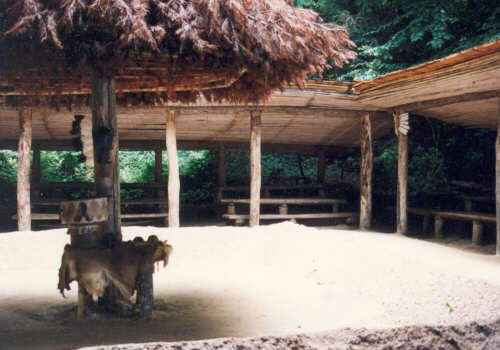
Having grown up in the Metropolitan Detroit area, I am well familiar with Greenfield Village. Oconaluftee Indian Village [text] is the Cherokee version of that, albeit on a smaller scale. It was certainly one of my favorite places on that 1995 trip. Unfortunately, my subsequent trips have not been "in season," so it is the only time I have been there. Oconaluftee Indian Village is a recreated version of a Cherokee village of the 1750s. During my tour there were many demonstrations from bead and pottery workers showing their skills to a canoe builder using fire. I have visited many interesting Cherokee historical sites since, but would not mind returning to Oconaluftee Village, now that I know a little more about Cherokee history. I highly recommend making it a part of any Cherokee NC visit. |
 |
 |
 |
||||
 |
 |
 |
||||
 |
 |
 |
||||
 |
 |
 |
||||
 |
 |
 |
||||
|
|
|
The Oconaluftee Indian Village complex included a Cherokee Arboretum and nature trail. The old cabin in the garden, which is reached by the nature trail, is one that was originally erected during the Civil War (five generations of Cherokees lived in it). But, this is not the only place to experience the "nature" of Cherokee, North Carolina . . . |
 |
 |
 |
||||
 |
 |
 |
||||
|
 |
|
. . . the town rests at the entrance to the Great Smoky Mountains National Park, and also the scenic Blue Ridge Parkway. Those are topics for other Scrapbook Photo pages to come, but here are two more pictures of Mingo Falls (top center opening this page, above left, and below left are the falls), and few of entering the area from the south. |
 |
|
||||||
 |
 |
|||
|
|
|
 |
||||||
|
|
|
I mentioned I went to the Qualla Arts and Crafts Co-op in 1995. I have been back, as well as to other suppliers in Cherokee to purchase many of the items in the Cherokee Heritage & Arts Display at the Center, as well as to get products to sell at CBTC. The many handcrafted items include double-weave river cane and oak basketry, pottery, wood carving, stone work, rattles and dance wands, ball play racquets, tomahawks, blow-guns and their darts . . . |
|
|||||||||||||||||
|
|
|
|


