FOOD PAGE - NEW CHOICES
Low Saturated Fat - Some Organic - Some Vegetarian


As mentioned on the opening page, on March 13th in 2006, I had quadruple by-pass open heart surgery.  After sifting through a barrage of "life changes" suggestions, I began focusing on saturated fats (the bad guys) and trans fats (the really bad guys; avoid them like the plague. Polyunsaturated fat is pretty much neutral, and monounsaturated fat is good for you, according to the nutritionists providing the cardiac rehab information).  I do not have salt or sugar issues (I all but eliminated the use of table salt years ago), so my choices were less complicated that many who undergo such surgery.  By seeking out products with no trans fat* and less than 2 grams of saturated fat per serving (the standard is under 20g SF per day, or under 10g if you already have heart or circulatory issues), and adding some exercise, I have been able to lower my cholesterol by as much as 77 points without the use of drugs.  But, life nonetheless needs a quality, not just a quantity.  For me, giving up everything I find enjoyable, to preserve life in this world, is simply not an option.  Fortunately, with a little bit of looking, there are alternatives.  I show some of what I've found below.  Beyond the numbers themselves, in general, whenever possible, opt for organic.  It will usually be more healthy for your overall well being.  Still, life is about balance, so don't get to the end of it wishing you had been a little less inhibited with your decisions. 

One final note.  We all know that the single biggest missing piece of healthy living for Americans is the exercise.  Heart surgery is a great motivator, and I now have a three day a week program I do pretty religiously.  My belief is you won't stay with a program you don't enjoy.  So search your heart for something you can, and don't wait for a surgery to get you started.   

*watch out for partially hydrogenated oils in the list of ingredients on a product.  Even though the product may say zero trans fat, manufacturers do not have to list anything under .5, so .49 could still be there and potentially add up.  The word hydrogenated is your clue to avoid it.  The exception to this is if it specifically says "fully hydrogenated."  That process tends to eliminate the trans fat, but for me that gets a little too complicated.  I stay clear of hydrogenated oils if I can.  

SF=Saturated Fat g; TR=Trans Fat g; PF=Polyunsaturated Fat g; MF=Monounsaturated Fat g; TF=Total Fat g; CH=Cholesterol mg; CA=Calories; CF=Calories From Fat; SA=Sodium mg; SU=Sugar g; FB=Fiber g; PR=Protein g; SS=Serving Size (a dash under any heading means the number was not shown on that product)

 
SF TR PF MF TF CH CA CF SA SU FB PR SS
0 0 - - 4.5 0 140 40 110 0 2 2 1oz

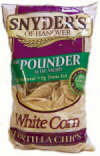
I use the Snyder's Tortilla Chips like any nacho chips and for crumbling onto  taco salads.  I find them locally at Horrock's and Meijer's. 

1oz = 13 chips  (is that whole chips or are broken pieces included?)
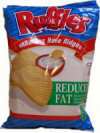
Potato chips were pretty much a staple of my diet.  Reduced Fat Ruffles had good enough numbers to remain in it.  Ruffles also has a .5 SF product, but it doesn't go on sale (as often) like these do. 

SF TR PF MF TF CH CA CF SA SU FB PR SS
1 0 2 4 7 0 140 60 180 0 1 2 1oz
 

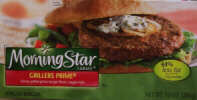
Hamburgers, hot dogs and lunch meats --- our diet doesn't get any more American than these.  Unfortunately, they are typically loaded with artery clogging fats.  You can use ground turkey (watch the fat content) for a hamburger, but if you purchase 95% (or better) lean beef, you are likely doing just as well.  I've also found a good vegetarian alternative in the "Grillers Prime" Morning Star burger.  It and their mushroom burger are the only vegetarian ones I truly enjoy. 

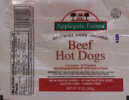
Unless you are fond of chewing on rubber, I would steer clear of veggie hot dogs.  However, my mother found a beef hot dog from Applegate Farms with only two grams of saturated fat (versus four to eight in a typical hot dog).  

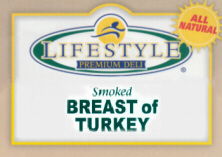
As far as lunch meats go, I look for 97% fat free ham and, though costly, all natural Lifestyle smoked turkey is not only low in fat, but free of nitrates as well.   I was not a big eater of bologna and salami previously, so I have not bothered seeking out an alternative for them.   


SF TR PF MF TF CH CA CF SA SU FB PR SS
1 0 4 4 9 0 170 80 360 0 2 17 1

 
SF TR PF MF TF CH CA CF SA SU FB PR SS
2 0 - - 4.5 20 70 40 340 0 0 6 1

 
SF TR PF MF TF CH CA CF SA SU FB PR SS
0 0 - - .5 35 60 5 400 1 0 12 2oz
 

I have had people joke after eating a big meal that we should go exercise it off.  Based on what others have said, it seems exercising after eating, or eating before exercising, is a common misperception.  In the heart classes at the hospital, I learned that if you eat just before any physical exertion, the energy the body would normally use in digestion gets diverted to the physical activity, and the food just sits in your stomach mostly undigested.  I eat something small or light about an hour before exercising, since it's also not good to exercise on a totally empty stomach.       


SF TR PF MF TF CH CA CF SA SU FB PR SS
0 0 0 0 0 0 110 0 100 22 1 2 32g

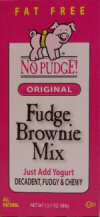
They're not quite apple pie, but brownies and frozen yogurt (substituting for ice cream) would certainly fit our American ways.  These No Pudge brownies are excellent, and easy to fix (just add a carton of yogurt to the mix).

I've only had the Homemade brand of frozen yogurt (vanilla, chocolate, and cherry cordial).  I liked it so well, I haven't tried any others.  In my opinion it tastes as good as (or better) than ice cream.  The numbers below are for the vanilla which I use a lot to make milkshakes (using 1/2 percent milk).

SF TR PF MF TF CH CA CF SA SU FB PR SS
1.5 0 - - 2.5 5 120 20 75 17 0 4 78g


SF TR PF MF TF CH CA CF SA SU FB PR SS
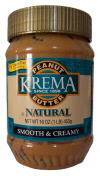
2 0 - - 16 0 190 140 80 1 3 8 32g

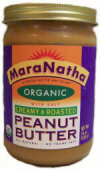
I have never been a big breakfast person, unless we were having it close to lunchtime.  But, I have started eating something first thing in the morning.  Peanut butter and homemade jelly on an English muffin or toast or perhaps a bowl of cereal.  Several big name companies are coming out with organic peanut butter now, but this MaraNatha still has the best numbers (and taste).

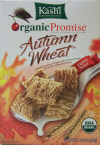
I was sort of notorious for having a mix of Cheerios, Honey Nut Cheerios, Rice Krispies, and Double Stuff Oreos for cereal.  I still use the first three, but the Oreos have been replaced by a cut up banana, cup of frozen wild blueberries (store bought), and a shredded wheat like Kashi's.  I like it. 

SF TR PF MF TF CH CA CF SA SU FB PR SS
0 0 - - 4.5 0 190 10 0 7 6 5 54g
 

During my time at Cardiac Rehab, I discovered it's easier mentally to exercise if I am switching between exercises rather than doing a single activity for 34 to 45 minutes.  I already owned a Health Rider (I hardly ever used - I was too tired after 3 or 4 minutes), so I purchased an inexpensive treadmill that folds upright.  They are in the same room as my computer.  I begin a slide show, put a music tape in with some rock and roll from the 60s, 70s, and 80s, and start with 12 minutes on the treadmill.  Then I move to the Health Rider for ten minutes, and after that, back to the treadmill for another twelve minutes.  The first two, and last two minutes on the treadmill are at lower speeds, as a warm-up and cool down time.  I follow this with some stretching exercises for about another 15 minutes.  The routines are those I learned at Cardiac Rehab.  Once you do something regularly for over a month, it pretty much becomes habit.  Now three days a week seems like no big deal.    


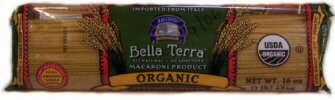
SF TR PF MF TF CH CA CF SA SU FB PR SS
0 0 - - 1 0 210 10 0 2 6 7 2oz

The above numbers are for the pasta I use when making spaghetti.  Below are the numbers for the organic eggs.  This Bella Terra product is excellent.  It's whole wheat.  It's organic.  And, it tastes as good as any other spaghetti I've ever eaten.  It boils up in about for minutes, and as a bonus, it goes on sale sometimes around here, so I can stock up when it does.

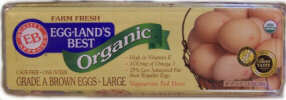
Eggs are tough customers for those of us with heart disease.  They are loaded with cholesterol.  The situation is improved if you use only the whites, but what's a good egg without the yolk?  Folks in the herbal and organic arena say free range organic eggs don't harbor the same bad cholesterol effects as regular eggs.   I've switched to those, but I'm still limiting myself to no more than three per week (recommended) until I see some science on it.

SF TR PF MF TF CH CA CF SA SU FB PR SS
1 0 - - 4 170 70 35 65 - - 6 1
 

Sometimes you simply need to give something up, or cut way back.  Cheeses are very high in saturated fats.  I previously used a lot of cheese.  It was surprisingly easy to mostly eliminate them though.  When I do use it, I go with 2% , or a Swiss or Mozzarella, which tend to be lower in saturated fat.  You have to read the labels.  We already used 1/2% milk, but one of my biggest disappointments was Hershey's milk chocolate.  A single Hershey's candy bar has 7 or more grams of saturated fat depending on the size of the bar.  Even the kisses, or other snack size ones, add up quickly.  I didn't eat chocolate all the time, but I would run in spells craving it.  Once in a great while I still give in to a bite, but it's one of the examples of something you're better off not getting started on.  And, the more I'm away from it, the less I like how I feel after I eat some. 


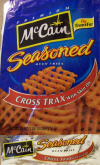
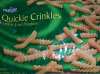
You are always better off starting fresh with a natural item (like potatoes).  But, let's face it, sometimes you just don't feel like doing the work.  This McCain French Fry product has low SF (although they changed oil in 2007 going from .5 to 1) and no TF (as do Betty Crocker boxed Julienne potatoes).  The list of ingredients is long, which always makes me wary.  But, it's a start.

SF TR PF MF TF CH CA CF SA SU FB PR SS
1 0 3 4 9 0 170 80 490 1 2 2 3oz

There are many more products I've switched to, and new products hit the store shelves regularly.  Bisquick (for my pancakes) now makes a heart smart version of it's product.  Honey mustard substitutes well on sandwiches for Miracle Whip, and when not, Miracle Whip has a low fat alternative.  I use Egg Beaters in baking and pancakes, and buy yolk-less noodles.  Canola and olive oil top out as the best for cooking, with safflower, sunflower, corn, soybean, peanut, and cottonseed oils heading down the chart to lard, palm, beef tallow, butterfat, and coconut oils as the worst.  Nuts, and beans, vegetables, and fruits have all become more prevalent in my diet.  I've found the trick is to keep them conveniently available.  We tend to reach for what's handy.  I started using herbs and vitamins quite a few years ago, but my food choices remained pretty poor until I was highly motivated.  You too can, of course, wait for a surgery or a heart attack to inspire you - or not.  The products are out there.  It takes a little knowledge, and the willingness to pay attention to what you are buying.  But, our American diets can improve while remaining tasty.  The more demand there is for quality, the more food producers will respond.  Good eating!   


Before I close this page, I'd like to make a special mention of the Grand Ledge Mancino's.  As far as fast food goes, the owner of this Mancino's has gone above and beyond in trying to offer healthy alternatives.  Here are some excerpts from one of his flyers:  Our meats are 97% fat free and above . . . We offer honey wheat and spelt pizza crusts made from the same recipe as our breads . . . We offer a gluten free menu, low fat cheese, fat free mayonnaise and fat free salad dressings to make your meal healthy and delicious . . . We are the only Mancino's that has this many bread choices, size options and healthy alternatives . . . We worked with St. Joseph Mercy Hospital to make our honey wheat and spelt breads "heart healthy choices."  


If you've had heart surgery, or know someone who has, or is about to, I found the following (link below) to be the most helpful information for the immediate weeks and months after surgery:

http://www.sts.org/sections/patientinformation/adultcardiacsurgery/heartsurgery/

Like with any other topic, the Internet has a wealth of information regarding heart healthy eating.


NEXT

Toward Better Health primary page